

Survivors Remember
- It was not your fault!
- You are a survivor!
- You are stronger than you know!
- You are not alone!
- Axios! You are worthy!
- Vera! It’s all true!
To get help, please visit ScamVictimsSupport.org and sign up for the SCARS Institute FREE Scam Survivor’s School at www.SCARSeducation.org
My Scam Victim Story/Survivor Story #89
Multiple Romance Scams
Survivor’s Country: USA
This is the original victim’s story, enhanced by the SCARS Institute Editorial Team to improve comprehension, readability, and continuity. The names were changed to protect the survivor’s identity.
WARNING: THIS SCAM VICTIM/SURVIVOR’S STORY MAY BE TRIGGERING TO SOME PEOPLE. DISCRETION IS ADVISED.
ADVERTENCIA: LA HISTORIA DE ESTA VÍCTIMA/SOBREVIVIENTE DE ESTAFA PUEDE SER INSENSIBLE PARA ALGUNAS PERSONAS. SE RECOMIENDA DISCRECIÓN.
If you need help, join our free SCARS Institute Support and Recovery Program at support.AgainstScams.org
Si necesita ayuda, únase a nuestro Programa gratuito de Apoyo y Recuperación del Instituto SCARS en support.AgainstScams.org
My Scam Victim Story
My 5th Scam

My name is Diana, and I’ve spent seventy-three years clawing through a world that never once paused to see if I was still breathing. Life started hard, with a father who drank his rage into fists and a mother who looked the other way, her eyes hollow like she’d already given up on saving herself, let alone me. I married young to escape, but that man turned out worse; his hands left bruises that faded slower than the fear. Twenty years ago, he tried to kill me, wrapping a cord around my neck in the kitchen while dinner burned on the stove. I fought, nails digging into his arms, gasping for air that tasted like metal. The neighbors heard the screams, called the police. He went to prison, and I went to the hospital, ribs cracked, throat swollen, soul shattered. Doctors said I was lucky. Lucky. The word still tastes like ash in my mouth.
I rebuilt what I could after that. Worked two jobs, cleaning houses and waiting tables, saving every penny for a little home in a quiet suburb, a car that ran reliable, a retirement fund that promised peace in my old age. I had no children, no family left, everyone scattered or dead; so that money was my safety net, my proof that I could survive on my own terms. Then, ten years ago, the scam started. It crept in like a whisper on a lonely night. I was on a dating site, not looking for love, just someone to talk to. His name was Robert, a widower from Canada, working on an oil rig. He sent photos of a handsome man with kind eyes, wrote poems that made my heart ache for something I’d never had. He listened when I talked about my past, and said he understood pain because he’d lost his wife to cancer. We chatted for months, his words wrapping around me like a warm blanket.
One day, he needed help. His rig had an accident, he said, and he couldn’t access his bank account. Just a loan, he’d pay back with interest. I sent $5,000, my emergency savings. Then more emergencies came—medical bills, legal fees, a stolen wallet. Each time, he promised it was the last, called me his angel, his reason to keep going. I believed him because believing meant I wasn’t alone. The scam lasted almost two years, draining $150,000, every cent from my savings, home equity loans, even pawning my mother’s jewelry. The bank foreclosed on my house; the repo man took my car. I moved into a tiny apartment, scraping by on Social Security, eating canned soup and skipping meals to pay rent. When Robert vanished, blocking me everywhere, the truth hit like a truck. I sat on the floor, sobbing until my throat burned, feeling that cord around my neck again, but this time, I’d tied it myself.
Denial came fast, a shield against the pain. It couldn’t be a scam, I told myself. Robert loved me. The money would come back. But deep down, the grief festered, a black hole sucking in light. I isolated myself, ashamed to tell friends; they’d think I was stupid, an old fool. Then, six months later, another message popped up. This one is from a lawyer named Michael, saying he’d found my money in a frozen account. He said, “The scammers had been caught,” but I needed to pay a release fee. $2,000. I scraped it together, borrowed it from a neighbor. Of course, it was another scam. Michael disappeared, too. The cycle repeated three more times. A banker promising recovery, an FBI agent needing clearance fees, a private investigator with inside info. Each time, I sent what little I had, clinging to hope like a lifeline. Each time, the hole grew deeper.
Now, I’m on my fifth. His name is Frank, a retired police officer from Florida. He contacted me through email, saying he’d seen my case on a victim database. The FBI has my money, he claims, $200,000 recovered from the scammers’ accounts. But to release it, I need to pay a small processing fee, $500 for paperwork. I know it’s too good to be true. My gut screams it, that same intuition that failed me before. But Frank sounds so sincere, his emails full of details about arrests, court dates. He calls me “ma’am,” shares stories of his own losses to build trust. I sit in my dim apartment, staring at the screen, my hands shaking. Part of me wants to believe, needs to believe, because if this is real, it fixes everything, the poverty, the loneliness, the endless nights crying over what I’ve lost.
I have attachment issues, I know that. The therapist told me so, the one I saw for a few months after the second scam. She said my past abuses made me cling to any kindness, like a drowning woman grabbing driftwood. But I don’t trust her. She’s young, hasn’t lived my life. And the sessions cost $100 each; I skipped meals to afford them, only to hear “let go” and “move on.” How do I let go when everything’s gone? The pain is constant, a weight on my chest, reminding me of that cord, the scams, the betrayals. Grief mixes with rage, rage at the scammers, at myself for being weak. Trauma whispers I’m worthless, that I deserve this.
Frank asks for the fee again. I have the money, scraped from odd jobs cleaning houses, the same work I did forty years ago. Sending it would mean hope, a chance to reclaim my life. Not sending it means accepting the scam, facing the void. My finger hovers over “send,” tears blurring the screen. The pain is raw, a wound that never heals, just scabs over until the next lie rips it open. I want to believe, God, I need to believe. But deep down, I know it’s another scam, another thief stealing the last shreds of my dignity. Yet, I can’t stop. The attachment pulls me in, promising relief from the emptiness. I press send, and the grief crashes anew.
I hesitate to trust again, but I want to. The scam stole my savings and confidence, yet not my will to heal. I picture Thomas’s fabricated smile and feel anger rise, then settle into resolve. I will not let him triumph. Each day, I take a step, however modest, toward reclaiming my life. The view outside my window, a distant hint of the river, mirrors my journey—unpredictable, vast, yet enduring. I cling to that, a silent vow to myself that I will rise again.
How did this story impact you?
Please leave your thoughts in a comment below.
Thank you!
If you need support, please join our free SCARS Institute Scam Survivor’s School Recovery Program at www.SCARSeducation.org
Please Rate This Article
[ratemypost]
Please Leave Us Your Comment
Also, tell us of any topics we might have missed.
[comment-form]
-/ 30 /-
Thank You to the Scam Survivor for Their Stories!
Please Share YOUR Story Here!
We Will Anonymize Your Story to Help Shield Your Identity!
PLEASE: Help support scam victims/survivors by leaving your comment above. Your comment demonstrates your support. Thank you.
Recent Reader Comments
[better_recent_comments number=”10″ format=”{avatar} on {post}: “{comment}” {date}” avatar_size=”30″]
PLEASE NOTE:
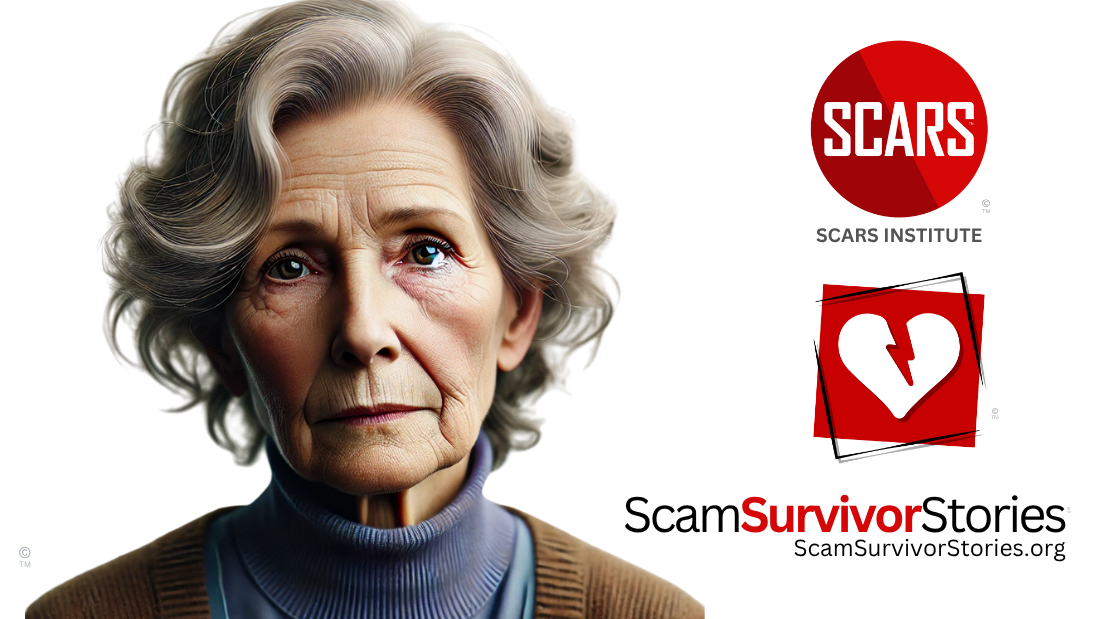
In the case of Scam Survivor’s Stories: The SCARS Institute displays this story to help recent scam victims. We are authorized to display this story and in this form or edition is copyright © Society of Citizens Against Relationship Scams Inc. All rights reserved. The specific survivor’s identity has been anonymized for their protection. Photos are generated and are not of the real person.
In the case of the Criminal’s Stories: The SCARS Institute presents the Criminal Stories to assist scam victims in understanding that criminals are real individuals, despite their terrible actions, and we can gain valuable insights from their experiences to prevent crime and identify these schemes as they emerge. We aim to support victims and survivors in releasing the emotions they harbor toward the criminals, fostering a path toward potential forgiveness over time.
Important Information for New Scam Victims
- Please visit www.ScamVictimsSupport.org – a SCARS Website for New Scam Victims & Sextortion Victims
- SCARS Institute now offers a free recovery program at www.SCARSeducation.org
- Please visit www.ScamPsychology.org – to more fully understand the psychological concepts involved in scams and scam victim recovery
If you are looking for local trauma counselors, please visit counseling.AgainstScams.org
If you need to speak with someone now, you can dial 988 or find phone numbers for crisis hotlines all around the world here: www.opencounseling.com/suicide-hotlines
A Question of Trust
At the SCARS Institute, we invite you to do your own research on the topics we speak about and publish. Our team investigates the subject being discussed, especially when it comes to understanding the scam victims-survivors’ experience. You can do Google searches but in many cases, you will have to wade through scientific papers and studies. However, remember that biases and perspectives matter and influence the outcome. Regardless, we encourage you to explore these topics as thoroughly as you can for your own awareness.
SCARS Resources:
- Getting Started For New Victims of Relationship Scams: ScamVictimsSupport.org
- FREE enrollment in the SCARS Institute training programs for scam victims SCARSeducation.org
- Subscribe to SCARS Newsletter newsletter.againstscams.org
- Sign up for SCARS professional support & recovery groups, visit support.AgainstScams.org
- Find competent trauma counselors or therapists, visit counseling.AgainstScams.org
- Report each and every crime, learn how to at reporting.AgainstScams.org
- Learn more about Scams & Scammers at RomanceScamsNOW.com and ScamsNOW.com
- Learn more about the Psychology of Scams and Scam Victims: ScamPsychology.org
- For Scam Victims Advocates: www.ScamVictimsAdvocates.org
- Self-Help Books for Scam Victims are at shop.AgainstScams.org
- Worldwide Crisis Hotlines: International Suicide Hotlines – OpenCounseling : OpenCounseling
- Campaign To End Scam Victim Blaming – 2024 (scamsnow.com)
More Survivor Stories



More Criminal Stories

A Note About Labeling!
We often use the term ‘scam victim’ in our articles, but this is a convenience to help those searching for information in search engines like Google. It is just a convenience and has no deeper meaning. If you have come through such an experience, YOU are a Survivor! It was not your fault. You are not alone! Axios!
Statement About Victim Blaming
Some of our articles discuss various aspects of victims. This is both about better understanding victims (the science of victimology) and their behaviors and psychology. This helps us to educate victims/survivors about why these crimes happened and not to blame themselves, better develop recovery programs, and to help victims avoid scams in the future. At times, this may sound like blaming the victim, but it does not blame scam victims; we are simply explaining the hows and whys of the experience victims have.
These articles, about the Psychology of Scams or Victim Psychology – meaning that all humans have psychological or cognitive characteristics in common that can either be exploited or work against us – help us all to understand the unique challenges victims face before, during, and after scams, fraud, or cybercrimes. These sometimes talk about some of the vulnerabilities the scammers exploit. Victims rarely have control of them or are even aware of them, until something like a scam happens, and then they can learn how their mind works and how to overcome these mechanisms.
SCARS Institute articles can help victims and others understand these processes and how to help prevent them from being exploited again or to help them recover more easily by understanding their post-scam behaviors. Learn more about the Psychology of Scams at www.ScamPsychology.org and www.ScamsNOW.com
Psychology Disclaimer:
All articles about psychology and the human brain on SCARS Institute websites are for information & education only
The information provided in SCARS Institute articles is intended for educational and self-help purposes only and should not be construed as a substitute for professional therapy or counseling.
Note about Mindfulness: Mindfulness practices have the potential to create psychological distress for some individuals. Please consult a mental health professional or experienced meditation instructor for guidance should you encounter difficulties.
While any self-help techniques outlined herein may be beneficial for scam victims seeking to recover from their experience and move towards recovery, it is important to consult with a qualified mental health professional before initiating any course of action. Each individual’s experience and needs are unique, and what works for one person may not be suitable for another.
Additionally, any approach may not be appropriate for individuals with certain pre-existing mental health conditions or trauma histories. It is advisable to seek guidance from a licensed therapist or counselor who can provide personalized support, guidance, and treatment tailored to your specific needs.
If you are experiencing significant distress or emotional difficulties related to a scam or other traumatic event, please consult your doctor or mental health provider for appropriate care and support.
If you are in crisis, feeling desperate, or in despair, please call 988 or your local crisis hotline.


This is one more reason why we should all be on here – reading the victims’ stories that have screamed for our attention. If we cannot listen to these sweet people who have had their lives changed forever, we are cold and callous people. None of us are. That is the description of the criminals who have stolen so much from us. We are in this position because we are good, loving people who just want someone to love us, to listen to us, to respect who we are and what we are. I am grateful you shared your story with us. Thank you and God bless you.
Thank you for sharing your story. You are a strong, courageous woman to rise above all the abuse – physical and emotional.
Your story shows the impact of childhood trauma that so many disregard as “children are small”. I saw what you saw and that made us wise beyond our years, yet didn’t prepare us for experiencing it ourselves.
Thank you for sharing this powerful story. I needed to be reminded today how vulnerable we all are to such evil people out there who steal our money, self respect and worth.